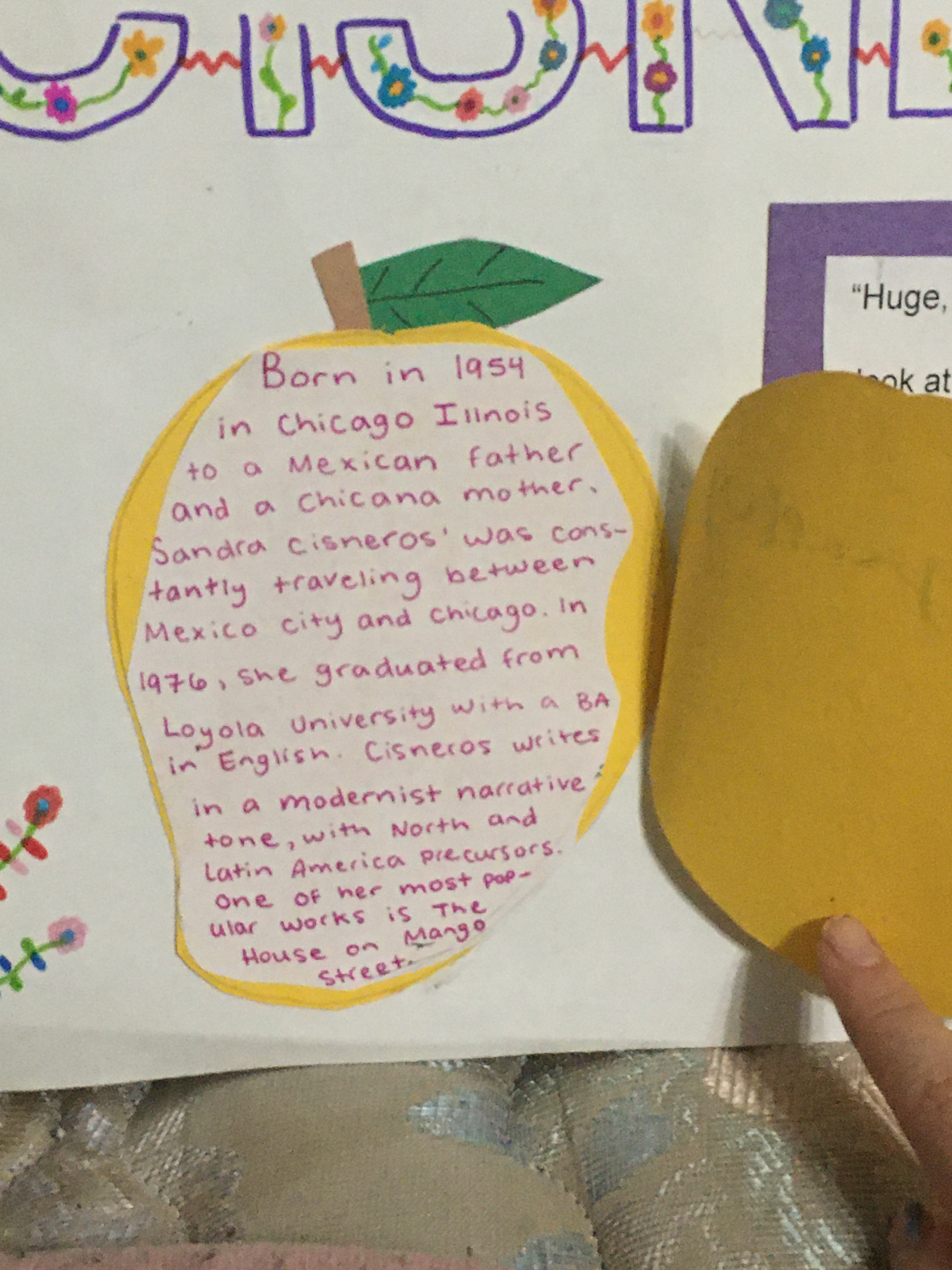
Sandra Cisneros
The Three Sisters
They came with the wind that blows in August, thin
as a spider web and barely noticed. Three who did not
seem to be related to anything but the moon. One with
laughter like tin and one with eyes of a cat and one with
hands like porcelain. The aunts, the three sisters, las co-
Madres, they said.
The baby died. Lucy and Rachel’s sister. One night a
dog cried, and the next day a yellow bird flew in through
an open window. Before the week was over, the baby’s fever
was worse. Then Jesus came and took the baby with him
far away. That’s what their mother said.
Them the visitors came… in and out of the little
house. It was hard to keep the floors clean. Anybody who
had ever wondered what color the walls were came and
came to look at that little thumb of a human in a box like
candy.
I had never seen the dead before, not for real, not in
Somebody’s living room for people to kiss and bless them-
selves and light a candle for. Not in a house. It seemed
strange.
They must’ve known, the sisters, They had the power
and could sense what was what. They said, Come here, and
gave me a stick of gum. They smelled like Kleenex or the
inside of a satin handbag, and then I didn’t feel afraid.
What’s your name, the cat-eyed one asked.
Esperanza, I said.
Esperanza, the old blue-veined one repeated in a high
thin voice. Esperanza … a good good name.
My knees, hurt, the one with the funny laugh com=
plained.
Tomorrow it will rain.
Yes, tomorrow, they said.
How do you know? I asked
We know.
Look at her hands, the cat-eyed said.
And they turned them over and over as if they were
looking for something.
She’s special.
Yes, she’ll go very far.
Yes, yes, hmmm.
Make a wish.
A wish?
Yes, make a wish. What do you want?
Anything? I said.
Well, why not?
I closed my eyes.
Did you wish already?
Yes, I said.
Well, that’s all there is to it. It’ll come true.
How do you know? I asked.
We know, we know.
Esperanza. The one with marble hands called me
aside. Esperanza. She held my face with her blue-veined
hands and looked and looked at me. A long silence. When
you leave you must remember always to come back, she
said.
What?
When you leave you must remember to come back
For the others. A circle, understand? You will always be
Esperanza. You will always be Mango Street. You can’t
Erase what you know. You can’t forget who you are.
Then I didn’t know what to say. It was as if she could
read my mind, as if she knew what I had wished for, and
I felt ashamed for having made such a selfish wish.
You must remember to come back. For the ones who
cannot leave as easily as you. You will remember? She asked
as if she was telling me. Yes, yes, I said a little confused.
Good, she said, rubbing my hands. Good. That’s all.
You can go.
I got up to join Lucy and Rachel who were already
outside waiting by the door, wondering what I was doing
talking to three old ladies who smelled like cinnamon. I
didn’t understand everything they had told me. I turned
around. They smiled and waved in their smoky way.
Then I didn’t see them. Not once, or twice, or ever
again.
~~~~~~~~~~~~~~~~~~~~~~~~~~~~~~~~~~~~~~~~~~~~~~~~
Here Cisneros again mentions the struggles that many teens face. These three sisters know almost that Esperanza wants to change who she is and one day leave this place, leave Mango Street for something better. It almost seems like a response to previous work, “My Name”. Where Esperanza used to feel uncomfortable with her name and tried to change it, but these women came and told her that no matter what she can’t forget where she came from. No matter how much she may want to trade her life, identity, and past experiences for someone else’s she can’t. The line that I feel perfectly encapsulates this feeling is when the sister with marble hands says to Esperanza, “You will always be Esperanza. You will always be Mango Street. You can’t Erase what you know. You can’t forget who you are.” I feel this really speaks to young Esperanza especially after how she had been feeling throughout The House on Mango Street.
Another feature I like in this poem is the imagery Cisneros uses. Especially when they describe the situation Esperanza’s at, like the small details that people wouldn’t think matter, or are important. Like the fact that a yellow bird flew through an open window, or that it was hard to keep the floors clean. The language and the small details that make one think that it was an average or regular day, when in reality this family’s world was turned upside down.


 Sassy Succulents